● Now availablePolysaccharide · Maillard · Aw · TgThe food science angle — not just the DE number
Maltodextrin Bulk EU Maillard · Aw · Tg · Dispersibility
The most technically differentiated maltodextrin guide available in English. Where maltodextrinbulk.de covers DE values and osmolality, this site goes deeper: polysaccharide spectrum positioning, Maillard reaction DE-dependence, dispersibility Instant Index, glass transition temperature stability, and an interactive water activity calculator — angles no competitor covers.
Maltodextrin in the polysaccharide spectrum — where it sits and why it matters
Maltodextrin is not a single compound — it is a family of partially hydrolysed glucose polymers sitting between native starch and glucose on the polysaccharide continuum. Understanding its position relative to other food hydrocolloids explains its functional properties better than DE alone.
Chain length determines function — not just DE
The degree of polymerisation (DP) — average number of glucose units per chain — governs every functional property. DP 20–50 (Maltodextrin DE 5): long chains → high viscosity, good film forming, high glass transition temperature (Tg ~205°C dry), slow Maillard, low osmolality. DP 4–8 (Maltodextrin DE 25): short chains → low viscosity, rapid dissolution, fast Maillard, high osmolality, low Tg (~65°C dry). Between native starch (DP 1000+) and free glucose (DP 1), maltodextrin DE 5–25 occupies the most technologically versatile window.
The digestibility boundary: The critical dividing line in the polysaccharide spectrum is digestibility. All α(1→4) linked glucose polymers — native starch through maltodextrin to glucose — are fully digested by human amylase. All β-linked polymers (inulin, FOS, pectin) and α(1→6) branched structures above ~DP 10 (resistant starch) are non-digestible dietary fibres. Maltodextrin sits entirely on the digestible side — there is no overlap with dietary fibre, no matter what the DE value.
Why inulin and maltodextrin are not interchangeable
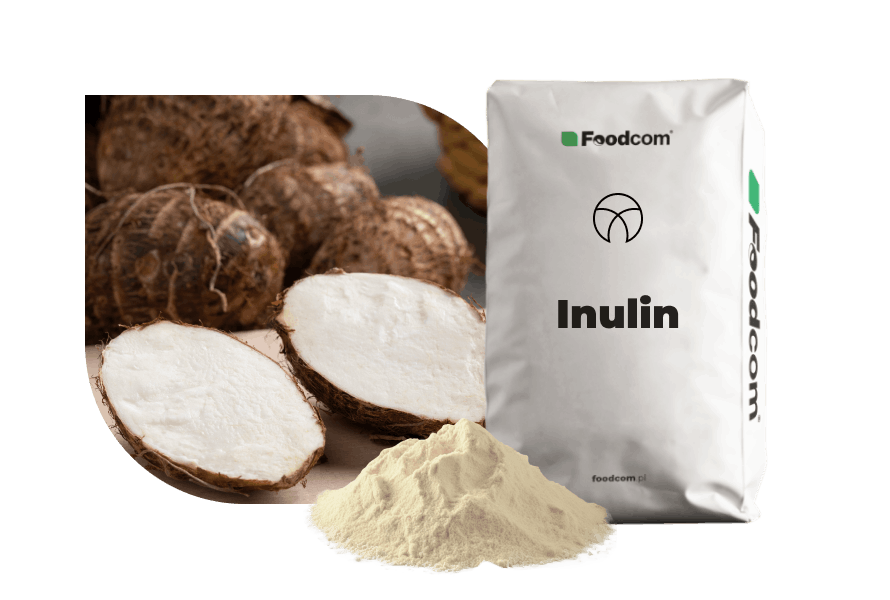
A common formulation error is substituting inulin for maltodextrin (or vice versa) without understanding that they are metabolically opposite. Inulin (β-linked fructose polymer): GI = 0, 1.5 kcal/g, prebiotic, dietary fibre for labelling. Maltodextrin (α-linked glucose polymer): GI 85–110, 4 kcal/g, fully digestible, not dietary fibre. When a formulator needs to: (1) reduce GI — use inulin, not maltodextrin. (2) add digestible energy carrier — use maltodextrin, not inulin. (3) add dietary fibre claim — use inulin. (4) achieve rapid energy for sport — use maltodextrin DE 15–25. Both are available from FDCM EU stock — the table below shows the full spectrum comparison.
Keto/IF audience note: Maltodextrin has a higher GI than table sugar and breaks any metabolic fast. Inulin (GI=0) does not break a fast and can be used in ketogenic formulations. This distinction is the single most important difference for supplement brand formulators targeting keto/IF consumers.
Polysaccharide
DP range
MW
GI
Cold solubility
Viscosity
Dietary fibre
Primary use
DP = Degree of Polymerisation (average chain length in glucose/fructose units). GI = Glycaemic Index (glucose=100). Maltodextrin rows highlighted. Data: literature values, 25°C.
Browning chemistry — interactive guide
Maillard reaction & maltodextrin — DE-dependent browning, flavour and colour
The Maillard reaction is the single most important flavour and colour development reaction in food processing — and maltodextrin's DE value determines how fast and intensely it proceeds. Click a DE grade to see optimal temperature, time and flavour profile.
Why DE determines Maillard rate — the reducing end mechanism
The Maillard reaction requires a free carbonyl group (reducing end) to react with an amino group. Every glucose chain has exactly one free reducing end — regardless of chain length. Therefore: a gram of maltodextrin DE 25 has approximately 5× more reducing ends per gram than a gram of maltodextrin DE 5 (because DE 25 chains are ~5× shorter, so there are ~5× more chains per gram). This directly translates to 5× faster initial Maillard rate at the same temperature and moisture.
The practical consequence for bakery, flavour development and protein blends: choosing the wrong DE can result in under-browning (DE 5, flat flavour) or over-browning and bitterness (dextrose or DE 25+, too intense). DE 15–20 consistently produces the most balanced, complex Maillard flavour profiles — rich caramel, toasted notes without bitterness.
Inhibiting unwanted Maillard browning: In spray-dried products (flavour encapsulation, protein powders), Maillard browning during drying causes undesirable colour and off-flavours. Three strategies: (1) use DE 5 instead of DE 15+ (fewer reducing ends); (2) acidify with citric acid (pH below 5 slows Maillard dramatically); (3) reduce outlet temperature below 80°C. All three strategies are available as formulation tools when ordering from FDCM.
Temperature & moisture interaction
Maillard rate is exponentially sensitive to temperature (Q10 ~3–5) and has an optimal moisture window of 10–20% (w/w). At very low moisture (<5%), molecular mobility is too low for efficient reaction. At high moisture (>30%), water competitively hydrates reactive groups. For baked goods: Maillard begins above ~100°C and accelerates rapidly above 140°C. For spray-dried applications: Maillard occurs during the brief high-temperature exposure at the spray nozzle (inlet air 150–220°C) — outlet temperature and residence time are critical controls.
Protein source matters too: whey protein concentrate (rich in lysine) reacts faster with maltodextrin than soy protein isolate (lower free lysine). This explains why WPC-based protein powders brown more quickly during drying than soy-based ones — and why DE selection becomes even more critical in WPC formulations.
Instant Index — scroll to animate
Dispersibility & Instant Index — which DE dissolves fastest in cold water?
Dispersibility measures percentage dissolution at 30 seconds in 20°C water. The Instant Index combines dissolution rate with lump formation score — a composite metric for consumer-facing instant products. Higher is better. Scroll to trigger animation.
Product
% Dissolved (30s · 20°C)
% Dissolv.
Instant Ix
Formulation insight: If you need DE 5 properties (film forming, high Tg, slow Maillard) but also fast dispersibility — blend with 20–30% DE 20–25 to raise the average dispersibility without sacrificing encapsulation performance. Alternatively, add 0.3–0.5% soy or sunflower lecithin as a wetting agent — it can increase dispersibility of low-DE maltodextrin from ~55% to ~80% at 30s.
Stability & Packaging Science
Glass transition temperature (Tg) vs DE — why Tg determines spray-dried product stability
Tg is the temperature at which the amorphous maltodextrin matrix transitions from rigid (glassy) to soft (rubbery). Above Tg: encapsulated compounds release, powders cake, shelf life collapses. The lower the DE, the higher the Tg — the more thermally stable the product.
The Tg-RH interaction — humidity is the hidden enemy
Water is a plasticiser — it dramatically reduces Tg. A maltodextrin DE 15 powder with Tg ~120°C in the dry state has Tg reduced to ~35°C at 11% relative humidity, and to ~5°C at 44% RH. Since ambient air in a non-air-conditioned warehouse in Southern Europe or Asia can exceed 70% RH and 35°C, this means DE 15 spray-dried products can become physically unstable in storage without moisture-proof packaging.
The Gordon-Taylor equation predicts: Tg mixture = (w₁·Tg₁ + k·w₂·Tg₂) / (w₁ + k·w₂) where w is weight fraction and k is a material constant. Adding sorbitol (Tg = -2°C) as plasticiser to improve dispersibility will dramatically lower the system Tg. Conversely, adding trehalose (Tg = 115°C) can raise the system Tg. For tropical market stability: DE ≤10 + moisture-proof packaging is the minimum specification.
The DE 5 advantage for encapsulation: Tg ~205°C (dry) and ~80°C even at 11% RH means DE 5 products can be stored at ambient temperature in standard poly-lined bags without caking — even in moderate humidity environments. This is the primary reason premium flavour houses use DE 5–10 exclusively for spray-dried flavour encapsulation.
Tg by DE grade — practical stability guide
DE grade
Tg (dry)
Tg (11% RH)
Tg (44% RH)
Stability assessment
DE 5
205°C
80°C
30°C
Excellent — stable to 80°C at 11% RH
DE 10
155°C
55°C
15°C
Good — stable to 55°C at 11% RH
DE 15
120°C
35°C
5°C
Moderate — caking risk above 35°C at 11% RH
DE 20
90°C
18°C
-5°C
Lower — requires moisture-proof packaging
DE 25
65°C
5°C
-15°C
Limited — high hygroscopicity, caking likely >25°C
RH = relative humidity. Tg values: literature data (Roos & Karel, 1991; Bhandari, 2012). Actual values depend on chain length distribution and presence of other components.
Shelf-life modelling
Water activity (Aw) calculator — maltodextrin DE vs concentration vs shelf-life
Water activity (Aw) controls microbial growth, chemical reactions (including Maillard) and physical stability. Maltodextrin reduces Aw — the extent depends on DE and concentration. Higher DE = more molecules per gram = stronger Aw depression per gram. Calculate your formulation's estimated Aw and shelf-life below.
Water activity (Aw) vs concentration for maltodextrin DE grades and sucrose
Maltodextrin DE 5
Maltodextrin DE 15
Maltodextrin DE 25
Sucrose (ref.)
Aw calculated using simplified Norrish equation. Actual Aw depends on complete formulation composition, other solutes, pH and temperature. These values are formulation design estimates — challenge testing required for final products. Sucrose shown for reference: sucrose depresses Aw more efficiently than maltodextrin at the same concentration due to its lower MW (342 g/mol vs thousands for maltodextrin).
Full catalogue
Maltodextrin & complementary ingredients — FDCM EU stock
Maltodextrin plus the ingredients most commonly used together in food, pharma and supplement formulations. All from EU stock with CoA per batch. Consolidated shipments in one DSV consignment.
Road freight from Warsaw EU warehouse. Full tracking, 3–7 business days. 25 kg minimum, no framework contract. Consolidated multi-ingredient orders ship as one consignment — one invoice.
Maltodextrin bulk EU — the food science FAQ no competitor provides
Covering the questions most search engines under-serve: fasting, resistant maltodextrin, dextrin vs maltodextrin, EU labelling, fat replacement, Maillard, Aw, Tg and more — all at formulator and food scientist level.
Yes. Maltodextrin breaks a fast at any meaningful dose. Despite having minimal sweetness at DE <15, maltodextrin is rapidly hydrolysed to glucose by intestinal amylase and triggers insulin secretion within minutes. GI 85–110 — higher than sucrose. For true metabolic fasting (insulin suppression, ketosis maintenance, autophagy): even 1–2g of maltodextrin is sufficient to break the fast. For people doing IF for gut rest only: trace amounts in supplements may be acceptable. There is no meaningful difference in fasting break between maltodextrin DE 5 and DE 25 — all forms are rapidly digested.
Both are starch hydrolysis products, but with critical differences. Dextrin (British gum, canary dextrin, pyrodextrin): produced by dry roasting starch at 150–230°C with acid — forms highly branched, partially random structures; DE typically undefined; water solubility variable; used as industrial adhesive, paper coating, and textile sizing. Maltodextrin: produced by controlled aqueous enzymatic or acid hydrolysis; DE strictly defined (5–28 by EU regulation); fully water soluble; consistent, food-grade. On food labels: 'maltodextrin' means controlled hydrolysis with DE <28. 'Dextrin' may mean either — check the specification. FDCM supplies maltodextrin with DE specification per batch.
Vegan: Always — maltodextrin is plant-derived (starch from corn, wheat, potato, tapioca). No animal products. Non-GMO: Depends on source. EU corn (most common): typically non-GMO (EU GMO regulations stringent). US corn: frequently GMO. Potato and wheat: almost exclusively non-GMO in EU. FDCM CoA includes raw material declaration. Allergens: Corn maltodextrin — no listed allergen (EU 1169/2011). Wheat maltodextrin — must declare 'gluten' despite technical gluten removal during hydrolysis (<10 ppm). Potato maltodextrin — no allergen. Specify your requirement at ordering.
Resistant maltodextrin (also marketed as 'soluble corn fibre', 'Fibersol-2') is NOT regular maltodextrin — it is a fundamentally different product. It is produced by further processing: after initial hydrolysis, the dextrins are repolymerised using pullulanase and other enzymes to create a highly branched structure containing α(1→2), α(1→3) and β linkages — these are not cleaved by human digestive enzymes (which only hydrolyse α(1→4) and α(1→6) linkages). Result: calorie content 1–2.4 kcal/g instead of 4 kcal/g, GI near zero, and prebiotic fermentation by gut bacteria. Regular maltodextrin (what FDCM supplies): DE 5–25, α(1→4) linkages only, fully digestible, 4 kcal/g, GI 85–110. If your formulation requires resistant maltodextrin for fibre content claims or calorie reduction, contact us — it is a different procurement requirement.
Maltodextrin reduces water activity (Aw) by binding free water molecules — the same principle as any dissolved solute (Raoult's law). The key difference between DE grades: higher DE = shorter chains = more molecules per gram = greater osmotic pressure = lower Aw at the same concentration. At 30% concentration: DE 5 gives Aw ~0.98, DE 15 gives Aw ~0.97, DE 25 gives Aw ~0.95, sucrose gives Aw ~0.91. Maltodextrin is less effective than sucrose at reducing Aw per gram of solute due to its higher molecular weight. However, maltodextrin is preferred when sweetness reduction is needed simultaneously with Aw control. For shelf-life extension: the combination of maltodextrin + sorbitol is synergistic — sorbitol provides additional Aw depression without increasing sweetness significantly.
Glass transition temperature (Tg) is the temperature at which an amorphous solid transitions from a rigid, glassy state to a soft, rubbery state. For spray-dried products using maltodextrin as encapsulant matrix: above Tg, the matrix softens, collapses, and releases the encapsulated compound (flavour, oil, probiotic) — dramatically reducing shelf life and creating caking. DE 5: Tg ~205°C (dry), ~80°C at 11% RH — excellent stability. DE 15: Tg ~120°C (dry), ~35°C at 11% RH — adequate for most applications but monitor humidity. DE 25: Tg ~65°C (dry), ~5°C at 11% RH — problematic in warm, humid climates; requires moisture-proof packaging. For spray-dried applications in tropical markets or without air-conditioning: always use DE ≤15. The higher the DE, the lower the Tg, the more hygroscopic the product, and the more likely it is to cake above 25°C at modest humidity.
The Maillard reaction requires two components: a reducing sugar (with a free carbonyl group) and an amino group (from amino acids, peptides, proteins). Maltodextrin participates as the reducing sugar component — every glucose chain has one free reducing end. Crucially, the DE determines the density of reducing ends per gram of maltodextrin: DE 25 has 5× more reducing ends per gram than DE 5. Higher DE = faster, more intense Maillard browning. Optimal for flavour development in baked goods and protein blends: DE 15–20. DE 5 browns slowly — useful when browning must be controlled. Pure dextrose browns fastest but bitterness develops rapidly above 155°C. The Maillard rate is also strongly pH and moisture dependent: accelerated above pH 7, optimal moisture 10–15%. Citric acid (pH reduction) is used to inhibit unwanted Maillard browning in spray-dried products.
Yes — but only in water-containing (aqueous) systems, and only at specific DE values and concentrations. Low-DE maltodextrin (DE 5–12) at concentrations above 20–25% forms a physical gel network at room temperature through hydrogen bonding between partially crystallised dextrin chains. The gel microstructure consists of particles 0.1–10 μm — the same size range as fat globules in emulsions. These particles provide lubrication and mouthfeel similar to fat. Fat replacement ratio: approximately 1g fat = 0.3–0.5g maltodextrin + 0.5–0.7g water. Calorie reduction: 9 kcal/g (fat) → 1.2–2 kcal/g (maltodextrin equivalent portion) = up to 87% calorie reduction in the replaced fat fraction. Limitations: does not work in anhydrous systems (chocolate, shortening); provides no fat-soluble vitamin carrier function; thermal stability of gel is limited (melts above 60°C).
Dispersibility measures how completely and quickly a powder dissolves in cold water (20°C) — critical for instant drink powders, supplement sachets, and dry-mix products. Maltodextrin DE 15–25 has excellent dispersibility (84–95% dissolution in 30 seconds at 20°C) — far better than native starch (<10%) or even dextrose (62%). The 'Instant Index' combines dissolution rate and lump formation score — higher is better for consumer experience. Low-DE maltodextrin (5–10) disperses more slowly and can form lumps if not pre-wetted. Formulation tip: if using DE 5 for encapsulation properties but needing instant dispersibility, blend with DE 20–25 or add a small amount of lecithin (0.3–0.5%) as wetting agent.
Maltodextrin and inulin are structural opposites despite both being polysaccharides derived from plants. Digestibility: maltodextrin fully digestible (4 kcal/g, GI 85–110); inulin non-digestible (1.5 kcal/g, GI ~0, dietary fibre). Linkage: maltodextrin α(1→4) glucose; inulin β(2→1) fructose — humans lack β-fructosidase, hence inulin's non-digestibility. Viscosity: maltodextrin low-medium; inulin low-medium (depends on chain length). Taste: maltodextrin slightly sweet above DE 15; inulin slightly sweet (60% of sucrose sweetness for short-chain). Maillard reaction: maltodextrin yes; inulin yes (fructose units are reducing sugars). For formulations targeting calorie reduction + fibre claim: blend inulin + maltodextrin — inulin provides fibre claim and prebiotic effect, maltodextrin provides carrier/texture function. FDCM supplies both from EU stock.
EU labelling under Regulation 1169/2011 and associated regulations: (1) Name: 'Maltodextrin' (acceptable) or 'partially hydrolysed starch' or 'glucose syrup' if DE >28. (2) Nutrient declaration: declared as carbohydrate (not sugar — no free monosaccharides or disaccharides unless residual from high-DE product). Calorie: 4 kcal/g (17 kJ/g). (3) Allergens: Wheat maltodextrin must declare 'Wheat gluten' in ingredient list even though actual gluten <20 ppm — EU regulation requires declaration of source, not actual gluten content. (4) Novel Food: Not novel food — long history of use before May 1997 cutoff. (5) Additive status: Not an additive — no E-number. Used quantum satis as a food ingredient. (6) Organic: Maltodextrin is permitted in organic products (EU 2018/848) if derived from organically grown starch crops. (7) GMO: If from GMO corn, must declare (EU 1829/2003 and 1830/2003).
Minimum order: 25 kg (one bag). No framework contract or annual volume commitment. Processing: 1–2 business days. Delivery: DSV road freight 3–7 business days to all 27 EU member states with full tracking. Standard CoA per batch includes: DE value (HPLC or Lane-Eynon method), dry matter content, pH in solution, viscosity at 20°C (10% solution), heavy metals (Pb, Cd, As, Hg per EU 231/2012), microbiological (TPC, coliforms, Salmonella, S. aureus, yeast & mould), sulphated ash, sulphur dioxide. On request at no charge: TDS, allergen declaration, non-GMO declaration, raw material source (corn/wheat/potato), halal/kosher certificate, Regulation 1333/2008 compliance letter, REACH declaration. Consolidated orders (maltodextrin + dextrose + inulin etc.) shipped as one DSV consignment — one invoice.
Order & Enquiries
Source maltodextrin bulk from EU stock
We respond to all B2B enquiries within 4 business hours
DSV road freight · 3–7 business days All 27 EU member states Full tracking from dispatch Delivery options →
Ready to source maltodextrin bulk from EU stock?
25 kg minimum · ≥99% purity · DE 5–25 by specification · CoA per batch · Vegan · Non-GMO EU · DSV delivery to all 27 EU member states in 3–7 business days.